From Visualising to Enacting Peace
By Roland Bleiker
28 Sept 2026
Context of this Blog
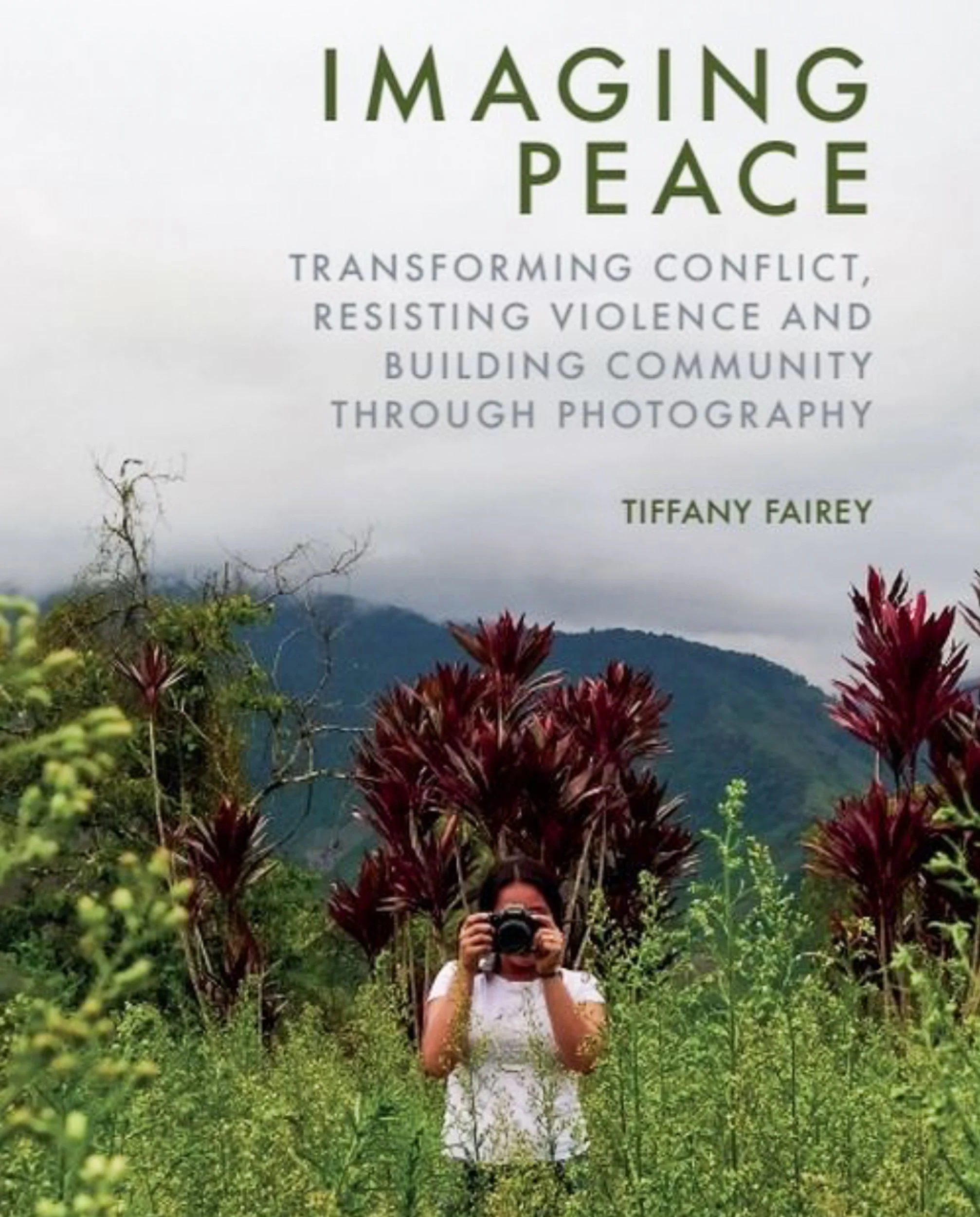
This blog is based on the Foreword I wrote for Tiffany Fairey insightful new book
Imaging Peace: Transforming Conflict, Resisting Violence and Building Community through Photography (Edinburgh University Press, 2026).
Also check out Tiffany’s Website for more information on the book and her work in general.
Photographs of violent events are engrained in our individual and collective consciousness. It might be the raising of the US flag on top of Mount Suribachi during the Second World War battle of Iwo Jima; it might be the depiction of naked Kim Phuc Phan Thi running away from a napalm attack during the Vietnam War; it might be 'tank man' at the Tiananmen Square protest in 1989; or it might be the more recent photo of two-year old Syrian refugee Alan Kurdi, found dead on a beach in Turkey.
We can all recall such iconic images of conflict and war. Countless books have examined the significance of these images and the photographers who became famous for taking them. Scholarly analyses have dissected the complex political dimensions of these icons in detail, paying attention to phenomena that range from 'negativity bias', 'war porn' and 'compassion fatigue' to the role that images of suffering play in raising humanitarian awarfeness and compassion.
But how many iconic peace photographs can we conjure up in our imagination? We might be able to think of this or that symbol. Perhaps a dove, an olive branch, the V sign? But, I assume, few of us would be about to recall a series of iconic peace photographs in the manner we can easily think of influential depictions of war.
***
Tiffany Fairey's new book addresses this puzzle and offers an exceptionally thorough and sophisticated contribution to a small but growing body of literature on peace photography. Fairey's account is a counterhistory; one that does not deny the need to visualise conflict and violence but places this political and visual history in conversation with movements that visually promote conflict resolution and peace.
What sets Imaging Peace apart is its combination of a sophisticated conceptual framework with detailed case studies that demonstrate empirically how peace photography works in different parts of the world. The book recognises that images — and visual factors in general — can fuel and entrench division, hatred and violence. But Fairey then explores how images can also promote peace. She first does so by offering an exceptionally useful overview - as well as a typology – of different scholarly approaches that have already explored the links between photography and peace. They range from photovoice, participatory photography and photo elicitation to photo mentoring and therapeutic photography.
While the concept of peace photography is relatively new, Fairey demonstrates that the associated practices have been around for a long time. When faced with conflict and difficulties, people have always tried to resist injustice and visualise a better world. In Imaging Peace we learn how this has been the case across different historical, geographical, cultural and political contexts. Case studies include Colombia, Rwanda, Nepal, Northern Ireland, Mexico and Bosnia and Herzegovina. It is fascinating to see how - across these highly diverse contexts - people have tried to harness the power of visuality to present their community's concerns and advocate for solutions to the problems they face.
***
I have, to be honest, struggled with writing a preface to Tiffany’s wonderful new book. I struggled because I find it hard to add something meaningful to a book that is so sophisticated and thorough. Anything I write runs the risk of appearing superficial in comparison to what Fairey offers: over two decades of practical experiences in and scholarly research on peace photography - all condensed in a compelling tour d 'horizon of the key issues at stake.
Rather than trying to summarise Imaging Peace, I will thus simply offer reflections based on reading the book. I do so without direct references to scholarly literature but with the hope of providing readers with extra motivation to closely follow Fairey's fascinating journey in Imaging Peace.
***
Peace photography is notoriously difficult to define. Scholars who had worked on this topic - from Debbie Lisle and Alex Danchev to Frank Möller, Rasmus Bellmer, Tom Allbeson, Pippa Oldfield and Jolyon Mitchell - had already drawn attention to this challenge. If peace and its visualisation are characterised by the absence of conflict and violence, then it is almost anywhere. And it is hard to pinpoint.
For Fairey, peace photography is both pluralist and intentional. She refers to the broad potential emerging from being able to see the world through the eyes of other people and beyond the often-constraining confines of the present. But visualising different worlds is not easy. This is why Fairey believes that peace has an 'image problem'. We — and I use the royal we here on purpose — often lack the collective imagination to envisage and enact a future that is less violent than the present one.
The power of peace photography emerges when one closely follows Fairey's central argument: that photography is 'generative'. Expressed in other words, photographs not only represent the world but also enact it. In this sense photography is also about power. When depicting the world, photographs determine how we see the world and, in doing so, also delineate what we can feel, think and politically debate and enact. As Fairey succinctly puts it: 'How we see peace, and who sees it, matters.'
***
A particularly fascinating — and important — part of Fairey's argument emerges as one travels along her conceptual and empirical journey. One then learns that the key to peace photography lies as much — if not more — in the process of taking, debating and circulating photographs as in the photographs themselves.
Imaging Peace documents in detail the processes through which conflict-affected communities around the world collaboratively employ photographs to transform conflict and to foster resilience, resistance, dialogue and healing. These processes are never straightforward but involve a constant oscillation between constraint and opportunity: a struggle to make visible a better world and to implement this vision in practice.
Photography, then, becomes part of a broader process through which local communities acquire the 'agency to have ownership over their stories'. Key to this ownership is having control over who is being depicted and over how best to represent experiences and signal aspirations for the future. Fairey here writes in the wake of the much-discussed local turn in peace studies: an approach that recognises the limits of externally imposed peace frameworks, which are often based on liberal Western principles that might not always work in local contexts. While acknowledging that such top-down approaches often erase local agency, Fairey is also careful not to idealise the local. Many conflicts emerge from the local and from deeply entrenched and hierarchical power relationships that entrench practices of inclusion and exclusion. Fairey knows and documents how peace photography is inevitably implicated in but also seeks to transform these very power relations.
***
A sceptical reader might ask: Why focus on peace photography in our current TikTok age, which seemingly revolves around the circulation of videos. Fairey has a compelling answer to this question. She outlines multiple reasons why photography remains an unusually powerful tool to promote peace activism.
One compelling argument for photography is its ability to recall memories, evoke curiosity and envisage alternative futures. Fairey notes that these creative potentials become even more powerful when one considers three more practical dimensions of photographs: their 'accessibility, mobility and durability'. Photographs are easy to produce and possess both on paper and digitally. People often keep them for years and cherish them as treasures that capture loved ones or special moments. Photographs might also symbolise aspirations for the future. Such visual messages can easily be shared and circulated - both in paper form and, again, even more so digitally.
This is why photographs work well when embedded in collective peacebuilding activities. They allow participants to focus on and represent what is meaningful to them and what type of activities and futures they would like to promote. In doing so, photographs make bridges between past, present and future.
In this sense, photographs highlight one of the most important but often neglected aspects of peacebuilding: that overcoming violent and problematic pasts is not just about establishing new political structures and processes, but also about dealing with the lived experience of people and their emotions. Without addressing these affective experiences - and the mixture of grievances and hope embodied in them — no lasting peace is possible. Working towards such forms of peace inevitably takes time and will always be a process, rather than an endpoint. This is why, in one of her case studies, Fairey writes of 'slow peace photography', of the type of photography that gradually and often inaudibly changes how people think and feel as well as how they view and interact with each other.
It is though these slow processes that photography has the potential to help transform conflict-affected societies and create more peaceful interactions. Fairey's impressive book shows us how communities have successfully done so in the past and how others might be able to do so in the future.
Sources and Readings
Allbeson, Tom, Pippa Oldfield and Jolyon Mitchell (eds). 2024. Picturing Peace: Photography, Conflict Transformation and Peacebuilding. Bloomsbury Press.
Bellmer, Rasmus and Frank Möller. 2023. Peace, Complexity, Visuality. Palgrave Macmillan.
Danchev, Alex and Debbie Lisle. 2009. 'Art, Politics, Purpose'. Review of international Studies 35 (4): 775-9.
Fairey, Tiffany. 2026. Imaging Peace: Transforming Conflict, Resisting Violence and Building Community through Photography. Edinburgh University Press.
Fehrenbach Heide and Davide Rodogno (eds). 2015. Humanitarian Photography: A History. Cambridge University Press.
Möller, Frank. 2019. Peace Photography. Palgrave Macmillan.
Möller, Frank, and David Shim. 2019. 'Visions of Peace in International Relations'. International Studies Perspectives 20 (3): 246-64.
Rancière, Jacques. 2004. The Politics of Aesthetics, translated and introduced by Gabriel Rockhill. Continuum.
Roland Bleiker is Professor of International Relations at the University of Queensland.